Quantum
internet


Building a secure quantum internet
A quantum internet is a radically new technology that connects (quantum) devices, such as quantum computers, over large distances. This will allow for novel innovations, including levels of privacy, security, and computation power that are impossible to achieve with today’s internet. At QuTech, our mission is to provide the enabling technology for the future quantum internet and showcase the very first fully functional quantum networks.
We are unique in that we’re working on every single aspect necessary for realizing quantum networks: we’re developing the software, the interface between software and hardware, and the hardware.

Quantum network protocols and application
Long-term goal:
To develop a full quantum network stack and novel applications for a quantum internet.
Highlights
Security has emerged as a key application for quantum technologies. One specific application is that of blind quantum computing, whereby a client can leverage very modest quantum resources to run a computation on a much more powerful server without revealing details of the computation. Previous protocols required extensive resources for accomplishing this task by forcing the client to hide not only the algorithm, but also all non-algorithmic sub-routines such as those to perform error-correction and generate magic states. In a recent work, we have designed a blind quantum computing protocol that enables the client to choose which elements of the computation they reveal, and which ones they keep hidden. This protocol enables us to significantly lower the requirements for performing fault-tolerant blind quantum computation, bringing secure delegated quantum computing closer to reality. (arXiv:2505.21621)
Quantum network hardware
Long-term goal:
Experimental demonstrations that push the frontier of quantum networking hardware and yield new enabling technologies and insights.
Highlights
The negatively charged tin-vacancy (SnV−) center in diamond has emerged as a promising platform for quantum computing and quantum networks. To connect SnV− qubits in large networks, in situ tuning and stabilisation of their optical transitions are essential to overcome static and dynamic frequency offsets induced by the local environment. We have achieved large-range optical frequency tuning of diamond SnV− centers using micro-electro-mechanically mediated strain control in photonic integrated waveguide devices. In addition, we employed real-time feedback on the strain environment to stabilize the resonance frequency and mitigate spectral wandering. These results provide a path for on-chip scaling of diamond SnV-based quantum networks. (Appl.Phys.Lett.)
We have demonstrated the efficient and low-noise conversion of single photons emitted by a SnV center to the telecom frequency band. This achievement is a key result for scaling SnV-based networks beyond the lab scale as photon loss in the telecom bands is much reduced. (Optica Quantum)
Quantum processors for quantum networks
Long-term goal:
To develop and exploit multi-qubit quantum processors for use in a quantum internet and networked computing.
Highlights
- Demonstrated high-fidelity universal quantum for spins in diamond. (Phys. Rev. Applied)
- Realised novel multi-qubit control gates for the SnV center. (Phys. Rev. X)
- Developed laser writing of coherent qubits in silicon-carbide. (arXiv:2603.23603)
- Calculated the thresholds for distributed quantum computation based on the surface code. (npj Quantum Information)
We experimentally optimised and demonstrated a universal quantum gate set with all fidelities above 99.9%, and with single qubit fidelities up to 99.999% based on the NV centre in diamond (Phys. Rev. Applied). Such high-fidelity gates are a crucial step towards larger error-corrected processors.
We have developed novel methods to control nuclear spin qubits that lead to improved quantum gates (PRX Quantum). We have applied these new tools to the case of the SnV center in diamond to show for the first time high-fidelity control of a small quantum register in this platform containing carbon-13 nuclear spins (Phys. Rev.X). These results open the door to multi-qubit protocols using the SnV platform as well as improved gate performance for the NV center platform.
For the emerging qubit platform based on the silicon-vacancy (VSi) in silicon carbide, we demonstrated the precise creation of highly coherent VSi qubits using focused laser pulses in industrial bulk-grown SiC wafers (arXiv:2603.23603). These qubits are promising for large scale integration and can operate at high operation temperatures (up to 20 Kelvin).
On the path of connecting many small quantum processors together into a large-distributed quantum computer, we investigated the threshold and logical failure rate of a fully distributed surface code (npj Quantum Information). We considered both emission-based and scattering-based entanglement schemes and link the performance to physical hardware. We compare architectures with one or two data qubits per module. For some entanglement schemes, thresholds nearing the thresholds of non-distributed implementations (~ 0.4%) appear feasible with future parameters reducing the performance gap between modular and monolithic quantum processors.
Quantum Network Explorer: unlocking the power of quantum networks
Long-term goals:
To showcase the world’s first quantum internet, make quantum internet technology accessible to the public, and build and engage a global community.
Highlights
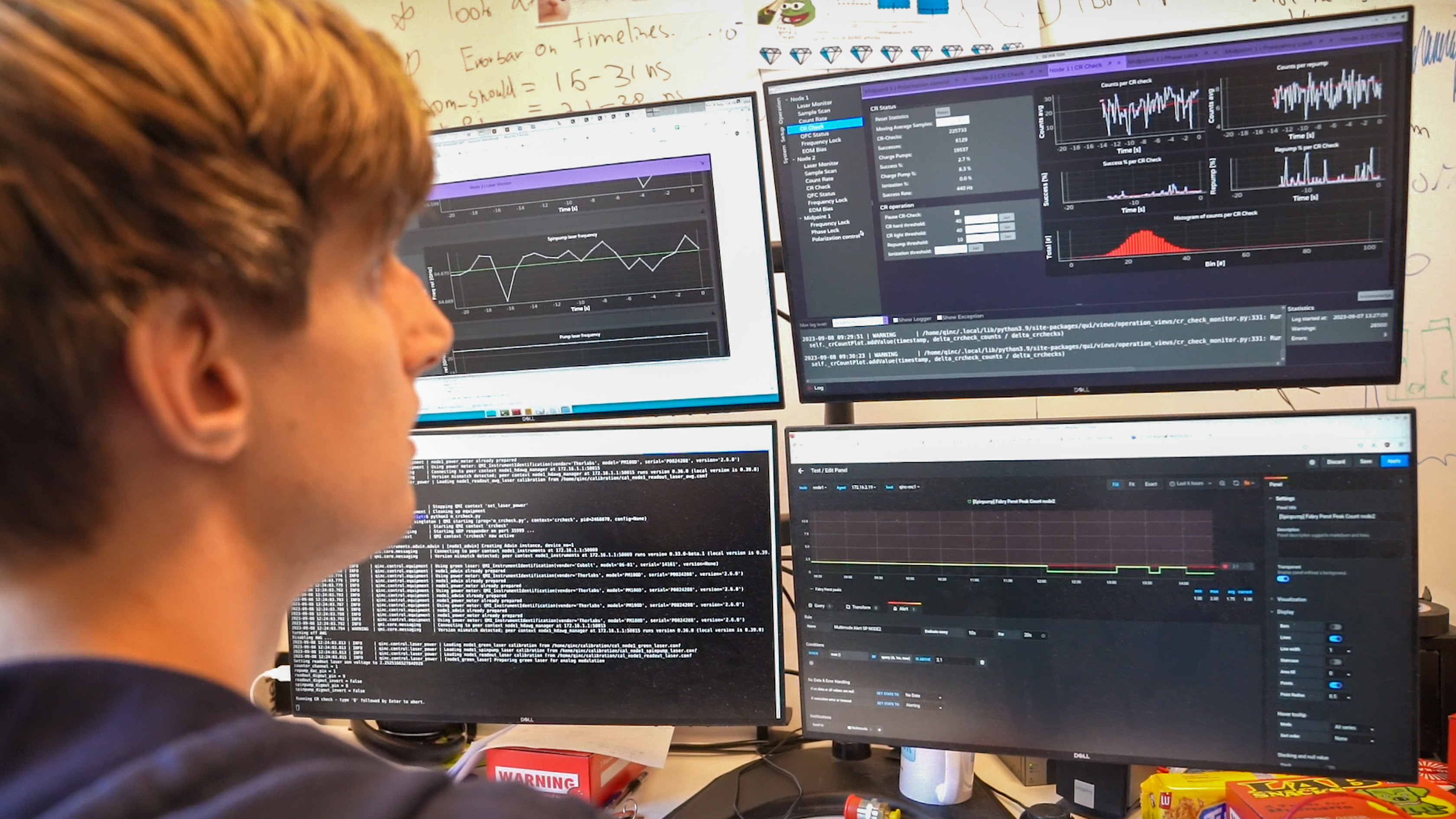
2025 was a year of further technical progress, with important steps towards full-stack system integration of QNE. We demonstrated stable two-node entanglement between NV center–based quantum processors, accessible through the QNE stack, enabling the execution of the first network protocols across real quantum hardware.
This progress allowed QNE to evolve as a versatile exploration platform for hardware, software, and application development. Enhancements to the simulation backends and user interface improved usability and enabled support for additional applications, linking to European initiatives and broadening the platform’s applicability.
Community engagement remained a key focus. The Quantum Internet Application Challenge attracted strong participation, and the Community Application Library was further expanded with new contributions, strengthening QNE’s role as a platform for learning, experimentation, and collaboration.
Next chapter:
Quantum computing