

Qubit
research


Next generation of qubits for quantum computing
The number one quantum computing challenge is that qubits (the basic units in quantum computers) are extremely fragile. Qubits are easily influenced by many things, like light and temperature. Quantum decoherence is what happens as a quantum system gradually loses its special quantum behaviour over time.
To overcome this challenge, we study new types of qubits that are by design protected from outside influences. These new qubits are referred to as ‘protected qubits’ and have the potential to outperform established technologies. We aim to understand, develop, and demonstrate protected qubits. In our efforts we combine material science, quantum theory, and novel device design.

New avenues for Majorana qubits
Long-term goal:
To develop a platform for topologically protected qubits with long coherence times and fault-tolerant quantum operations.
Highlights
We continued to study Majoranas in Kitaev chains engineered in quantum dot-superconductor hybrids in more detail. We demonstrated that quantum dots separated by almost a micron could still be effectively coupled to create Majoranas, and that magnetic flux could be used to increase the parameter space in which Majoranas are observed (Phys. Rev. Lett.).
We have demonstrated the enhanced stability in Kitaev chains in nanowires by extending from a 2 to a 3-site chain (Nature Communications)
We have demonstrated single-shot readout of the parity using quantum capacitance in a Kitaev chain (Nature)
We showed how to simulate a braiding experiment in a linear quantum dot array, and discussed how to mitigate for imperfections (Phys. Rev. B)
We demonstrated how a commonly used theoretical marker of topology can fail in systems that are of experimental relevance (SciPost Phys. Core)
Novel superconducting and hybrid qubit architectures
Long-term goal:
To develop new qubits based on superconducting circuits with intrinsic protection against noise and with gate fidelities outperforming conventional qubit architectures.
Highlights
We demonstrated a proximitised quantum dot in germanium heterostructure, a Group-IV semiconductor with novel properties for interfacing with superconductivity, with the potential for more coherent, gate-controlled qubits such as Andreev and 0-pi circuits. (Nature Materials).
We made headway in the automated tuning of gate-controlled quantum devices, demonstrating autonomous bootstrapping of a quantum dot from an untuned heterostructure to a double quantum dot (Physical Review Applied), as well as a quantum point contact (Physical Review Letters) bringing us one step closer towards scalable operation of quantum systems.
We demonstrated fast microwave-driven two-qubit gates between fluxonium qubits mediated by a transmon coupler, enabling efficient entangling operations in a strongly anharmonic superconducting platform. (Phys. Rev. Applied)
We developed a framework for single-qubit gates beyond the rotating-wave approximation for strongly anharmonic, low-frequency qubits, providing accurate control models in regimes where standard approximations break down. (Phys. Rev. Research)
To achieve better readout in the future for unconventional qubits, we proposed a mixed spin-boson coupling scheme that suppresses residual shot-noise dephasing, enabling higher-fidelity qubit measurement without sacrificing coherence. (arXiv)
Next chapter:
Innovation &
collaboration

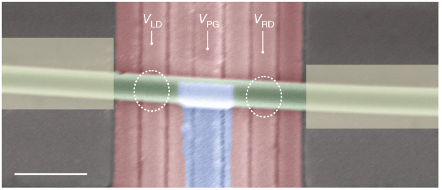
SEM image of a nanowire-based quantum dot-superconductor hybrid device to realize Kitaev chains
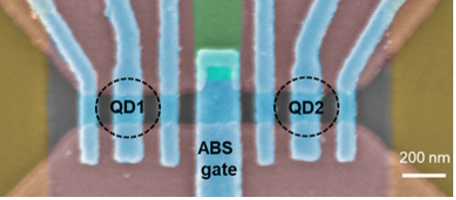
SEM image of a 2DEG-based quantum dot-superconductor hybrid device to realize Kitaev chains
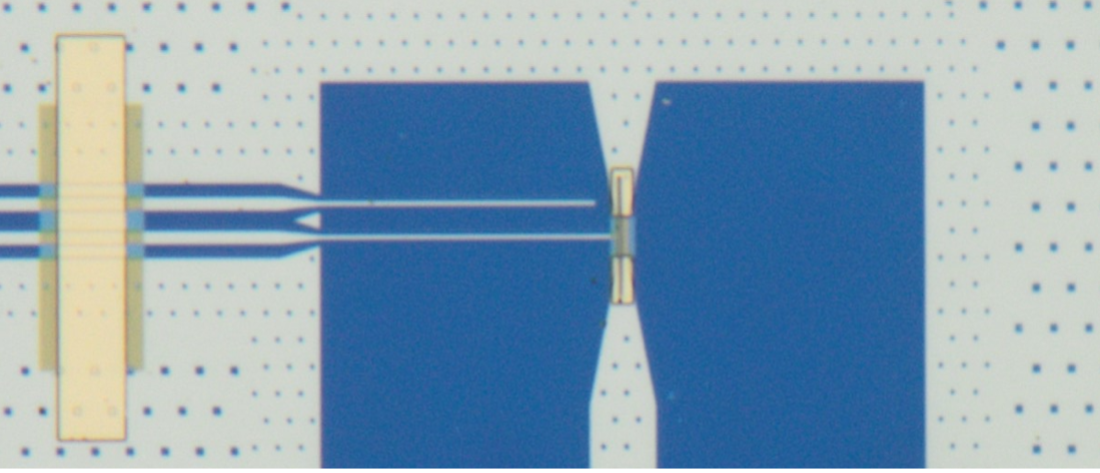
Optical micrograph of a nanowire integrated into a superconducting resonator